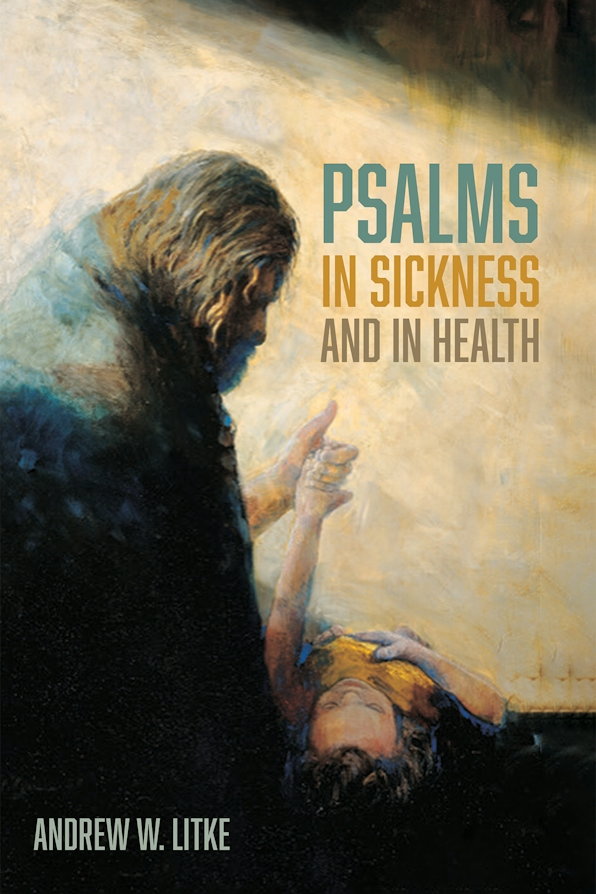
When you or someone you love is sick, suffering, and in pain, how do you respond? How do you navigate the emotional and relational struggles that accompany illness? How do you hold onto faith in a God who has promised to be with his people when you feel so isolated and alone? Like us, the writers of the biblical psalms struggled with illness and the ways that the brokenness of the world affected their bodies, emotions, and communities. The poets responded with screams, cries, and questions, but they also gave thanks, praised, and reflected on their broader community. In this book, Andrew W. Litke brings together the biblical psalms that deal with health, both psalms of lament and psalms of thanksgiving. He gives them new life with fresh translations and carefully unpacks the layers of meaning in the psalms, showcasing the unique voice of each poet. Taken together, Litke shows how these psalms display a profound diversity of religious expression in the face of struggle, an astonishing level of honesty and vulnerability with God, and an encouraging depth of courageous faith for all those who struggle.
Quotes
Public domain, via Wikimedia Commons
“The Gospel authors present Jesus as someone who recognizes the presence of illness as a reality. Illness reflected and symbolized a world that was broken by sin in a general way, not the sin of individuals. Jesus’s individual acts of healing showcased the weakening hold that sin and death have over the world.” p. xx
“God is not interested in our pious platitudes or our artificial positivity. He wants us—no matter how dark that can be.” p. 25
“And while the poet doesn’t provide us with much hope here, he does leave us with the knowledge that he is still crying out. It’s not pretty or encouraging, but he’s still crying out. And if he really believed that he was shouting to no one, he wouldn’t shout at all. This sliver of hope may be the strongest example of his faith.” p. 26
“Artistic creation is a form of power in a powerless situation.” p. 35
“Without the lament, praise in the face of difficulty is disingenuous. Without the praise, lament becomes hopeless bitterness.” p. 37
“It is a tremendous encouragement to hear someone’s story and see how they were able to make it through difficulties. Refusing to be silent, the poet seeks to be this encouragement for those around him. His message is clear: as bad as it is, God can change it. If you are sick, God can heal. If you are near death, God can revive. If you are mourning, depressed, or anxious, God can bring joy and peace.” p. 66
“Sometimes the idea of praising God infuriates or depresses us. We don’t feel his presence. We feel abandoned. We don’t feel his devotion and faithfulness. We feel anger. And yet the liturgy of praise persists. It refuses the dark abyss of our self-isolation, that destructive tendency to turn away from people at the time when we most need them. It gives us words when we have none. It reminds us to hope when we have no more energy to do so.” p. 107
“There are no more metaphors, only clear promises from a God of action: I will secure—I will protect—I will answer—I will be with—I will rescue—I will honor—I will sate with long life—I will show my salvation.” p. 121

Public domain, via Wikimedia Commons
Praise
Chuck DeGroat, Professor of Pastoral Care, Western Theological Seminary
With deep wisdom, raw honesty, and theological insight, Andrew W. Litke invites us into the Psalms as a sacred refuge for those walking through the valleys of illness, grief, and suffering. Drawing from both personal experience and careful biblical scholarship, he illuminates how the psalms give voice to our deepest laments yet also offer profound hope. This book is a gift to anyone seeking solace in Scripture amid life’s hardest seasons. A must-read for caregivers, pastors, and all who long to encounter God in their pain.
Tremper Longman III, Professor Emeritus of Biblical Studies, Westmont College
Speaking of the book of Psalms, Calvin rightly claimed, ‘there is not an emotion of which any one can be conscious that is not here represented as in a mirror.’ David Hubbard, former president of Fuller Theological Seminary, said that there is a psalm for every season of our life. Andrew Litke presents to us psalms that speak to us when we find ourselves in a season of sickness. His fresh translations and his penetrating commentary open up these psalms so they can become our own prayers and bring us closer to God even as we struggle.
William P. Brown, William Marcellus McPheeters Professor of Old Testament, Columbia Theological Seminary
With the kind of pastoral sensitivity born only from personal experience, Andrew Litke explicates certain psalms of lament, thanksgiving, and trust to reveal how they equip persons facing distress with prayer, hope, and wisdom. Beginning with his own, fresh translations, Andrew lovingly shows how the psalms can speak to us, with us, and for us. His book is a gift to the church, an indispensable pastoral resource for all who suffer, in whatever form, and for those who provide care.
David M. Hanke, Rector, Restoration Anglican Church, Arlington, Virginia
Psalms in Sickness and in Health offers an unfiltered encounter and deeply pastoral guide for the psalms. With fresh translations and keen insight, Andrew Litke invites us into the raw honesty of Scripture, showing how God meets us in our pain and draws us into deeper faith. A gift to anyone seeking God in the midst of illness and struggle. An invitation for everyone to slow down, listen, and find their cry in these ancient prayers.